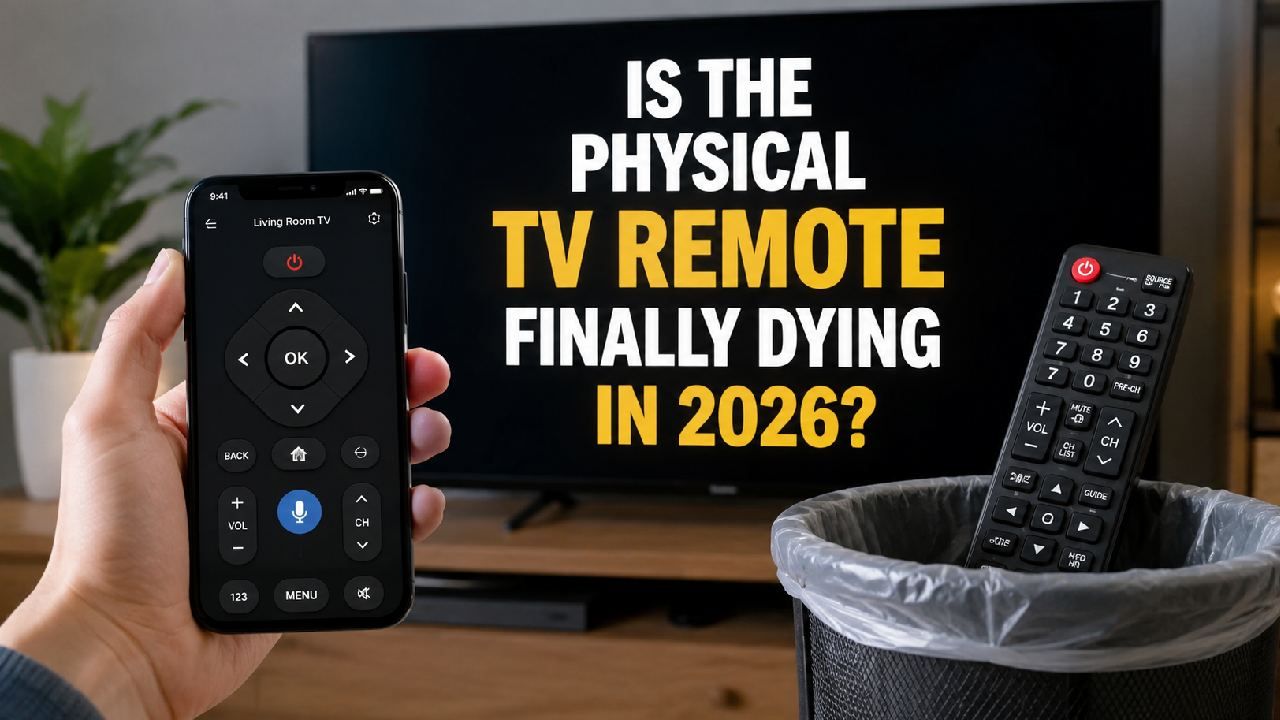
You are sitting on the couch, your TV remote disappears into the sofa cushions again, and your phone is already in your hand. That everyday moment explains why 2026 feels different. Industry trends, smart TV adoption, and user behaviour all point to the same answer: yes, the physical TV remote is slowly losing its place as the primary way people control their TVs.
Apps like Universal TV Remote Control by Codematics are leading the shift by giving users faster, smarter, and more convenient control directly from their phones.
The Numbers: How Physical Remote Use is Declining
Physical TV remote usage is declining because smartphones have become the default control device in modern households. According to industry analysts, 2026 marks the inflexion point at which smartphone-based TV control overtakes physical remote usage in key markets.
The transition did not happen overnight. One of the clearest early signals came in 2021 when Logitech discontinued its Harmony remote lineup, leaving millions of users without a future hardware ecosystem. Reports estimated that more than 25 million Harmony devices were already in use worldwide, indicating massive demand for universal control but shrinking interest in dedicated remote hardware.
Smart TV growth accelerated the shift even further. Most modern televisions now include native mobile app pairing support right out of the box. Samsung, LG, Sony, Hisense, TCL, Roku, and Vizio TVs increasingly encourage users to connect via mobile apps during setup rather than relying entirely on bundled remotes.
Global smart TV penetration has now crossed 60% of TV households in many developed regions. That means most new televisions are already connected to WiFi and ready for app-based control from day one. As smart home ecosystems continue expanding, consumers are becoming more comfortable controlling multiple devices from a single phone rather than juggling separate remotes.
The data shows a clear behavioural shift. Younger users already treat their phones as the primary interface for entertainment, streaming, communication, and now television control.
Why Users are Switching: Real Pain Points with Physical Remotes
People are switching to phone-based TV control because physical remotes create daily frustrations that apps solve instantly.
Lost remotes remain the biggest reason users download a remote app. Many user reviews mention searching under cushions, beds, and tables before finally installing an app instead.
Dead batteries always seem to happen at the worst time, especially during live sports, movies, or family viewing sessions.
Hotel and motel TVs often have locked or missing remotes, making mobile apps the easiest workaround for guests.
Older adults sometimes struggle with tiny physical buttons and faded labels, while mobile apps offer larger layouts and clearer navigation.
Homes with multiple TV brands often end up with drawers full of different remotes. One universal app simplifies everything into a single interface.
Shared households prefer phone control because everyone already has their own device nearby, rather than competing for a single remote.
The convenience factor matters most. People rarely forget their phones, and they already use them throughout the day. Using the same device to control the TV feels natural rather than like an extra step.
Can't Find the Right App for Your Hisense TV Model? Here's What Actually Works in 2026
What Phone-Based Control Offers that Physical Remotes Never Could
Phone-based TV control offers features that traditional remotes simply cannot match. Modern remote apps are no longer basic channel changers. They function as full entertainment control hubs.
Voice control is one of the biggest advantages. Users can search for shows, launch streaming apps, change volume, or switch inputs using voice commands instead of manually navigating menus. Universal TV Remote Control by Codematics includes voice control, making hands-free interaction faster and easier.
Full keyboard input dramatically improves usability. Typing passwords, searching YouTube, or entering streaming app logins with a physical D pad is frustrating. A phone keyboard completes the same task in seconds.
Touch navigation also feels more intuitive for many users. Swipe gestures, touchpads, and digital D-pads enable smoother scrolling through streaming menus than traditional button presses.
Multi TV management has become another major advantage. One app can control televisions across different rooms and different brands without forcing users to keep separate remotes for each device.
Dual connectivity support is especially important. Universal TV Remote Control by Codematics works via both WiFi and IR. Wi-Fi support enables smart TV control, while IR support also allows compatible phones to control older non-smart TVs. That flexibility makes the app useful across almost every television generation.
Brand compatibility is another reason users are making the switch. The app supports more than 700 TV brands, including Samsung, LG, Sony, Roku, Hisense, TCL, Philips, Panasonic, Toshiba, and Vizio.
The biggest advantage may simply be accessibility. Your phone is almost always charged, always nearby, and already part of your daily routine.
The Case for Physical Remotes: What they Still do Better
Physical remotes still offer advantages that some users prefer. Dedicated buttons provide tactile feedback that works well in dark rooms without needing to look at a screen.
Traditional IR remotes also work instantly without depending on WiFi connectivity. Even if the internet goes down, basic television functions continue working normally.
Some users also prefer to keep their phone's battery separate from entertainment controls. Long viewing sessions can slightly increase phone battery usage when remote apps stay active.
Physical remotes can also feel simpler for children and elderly users who are already comfortable with dedicated buttons and familiar layouts.
However, these advantages are becoming smaller each year. IR support in mobile apps now reduces internet dependency, modern phones easily last all day on a single charge, and cleaner app interfaces are becoming easier for all age groups to understand. The gap between hardware remotes and mobile apps is narrowing quickly.
IR Blaster vs WiFi TV Remote App - Which One Do You Actually Need?
130 Million Users can't be Wrong: What the Adoption Data Shows
Real-world adoption data shows that remote apps are no longer niche tools. They are becoming mainstream entertainment utilities used by millions every day.
Universal TV Remote Control by Codematics has surpassed 130 million downloads in more than 100 countries and supports over 700 TV brands. That scale reflects actual user behaviour, not just marketing trends.
The app succeeds because it works across both premium smart TVs and older television models. Wi-Fi connectivity handles smart TV control, while IR support also allows compatible phones to connect to non-smart TVs. That broad compatibility expands adoption beyond high-end households.
Users in developed and emerging markets alike continue to move toward app-based control because it reduces friction. Many reviews mention that the app worked better than the original remote or succeeded where other remote apps failed.
The global reach also matters. Different languages, TV ecosystems, and viewing habits still point to the same pattern: people increasingly prefer to control entertainment from the device already in their pocket.
As smart TVs continue replacing older televisions, mobile remote usage will likely grow even faster over the next few years.
What's Next: Voice, Smart Home, and the Remote of 2030
The future of TV control is moving toward voice interaction and smart home integration. Voice commands through Alexa, Google Assistant, and in-app systems are becoming more accurate and more natural every year.
Smart home standards like Matter are also changing expectations. Television control is becoming part of larger connected-home ecosystems in which lights, speakers, streaming devices, and TVs work together through a single interface.
Privacy concerns still remain part of the conversation. Some users remain cautious about always-on microphones and connected entertainment systems. That hesitation may slow the adoption of full voice for certain households.
Remote apps are also evolving beyond control tools. Many now integrate recommendations, watch history, streaming shortcuts, and personalised entertainment discovery features directly into the remote experience itself.
Physical remotes will not disappear overnight, but their role is changing. Instead of being the primary interface, they are increasingly becoming backup accessories for a phone's first entertainment experience.
The shift is already happening. 2026 is simply the tipping point where the trend becomes impossible to ignore.
Try the Remote App, 130 Million Users Trust
Yes, 2026 is the turning point for the decline of physical TV remotes. Smartphones are replacing traditional remotes because they solve everyday frustrations, offer smarter features like voice control and keyboards, and work with TVs from multiple brands on a single device.
If you have not already switched, Universal TV Remote Control by Codematics is free to download and supports more than 700 TV brands via both WiFi and IR.
Android Download: https://play.google.com/store/apps/details?id=codematics.universal.tv.remote.control
iPhone and iPad Download: https://apps.apple.com/us/app/universal-tv-remote-control/id1492122256
FAQs
Is the physical TV remote becoming obsolete in 2026?
Physical TV remotes are not yet fully obsolete, but 2026 marks the tipping point. Industry trends and user adoption data indicate that smartphone-based TV control apps are becoming the primary remote control solution for many households, especially those with smart TVs. Physical remotes are gradually shifting to backup devices rather than primary interfaces.
Can a phone app fully replace a physical TV remote?
Yes, for most users, a phone app can fully replace a traditional TV remote. Universal TV Remote Control by Codematics supports both WiFi and IR connectivity, works with more than 700 TV brands, and includes advanced features like voice control, keyboard typing, and multi-TV management.
What happens if my WiFi goes down? Can I still use a phone remote app?
Yes, if your phone includes an IR blaster. Universal TV Remote Control by Codematics supports IR connectivity that works without WiFi. WiFi is only required for network-based communication with smart TVs
Why do so many people prefer remote apps over physical remotes?
People prefer remote apps because physical remotes are frequently lost, damaged, or limited in functionality. Phone apps provide faster typing, voice search, multi-TV support, and the convenience of using a device that is already nearby throughout the day.
Which is the best free TV remote app in 2026 for Android and iOS?
Universal TV Remote Control by Codematics is one of the leading free TV remote apps in 2026. It has more than 130 million downloads, supports over 700 TV brands, works through both WiFi and IR, and is available for both Android and iOS devices.